




|
|
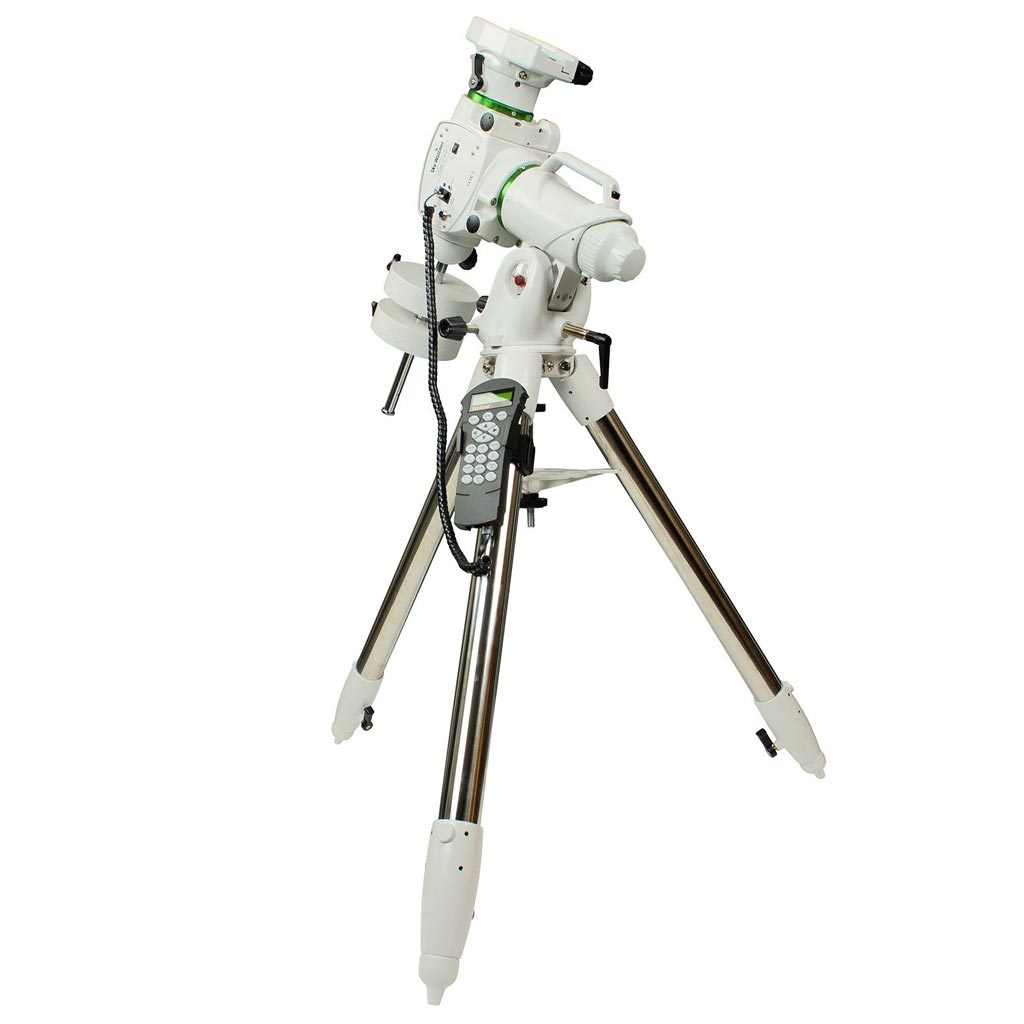
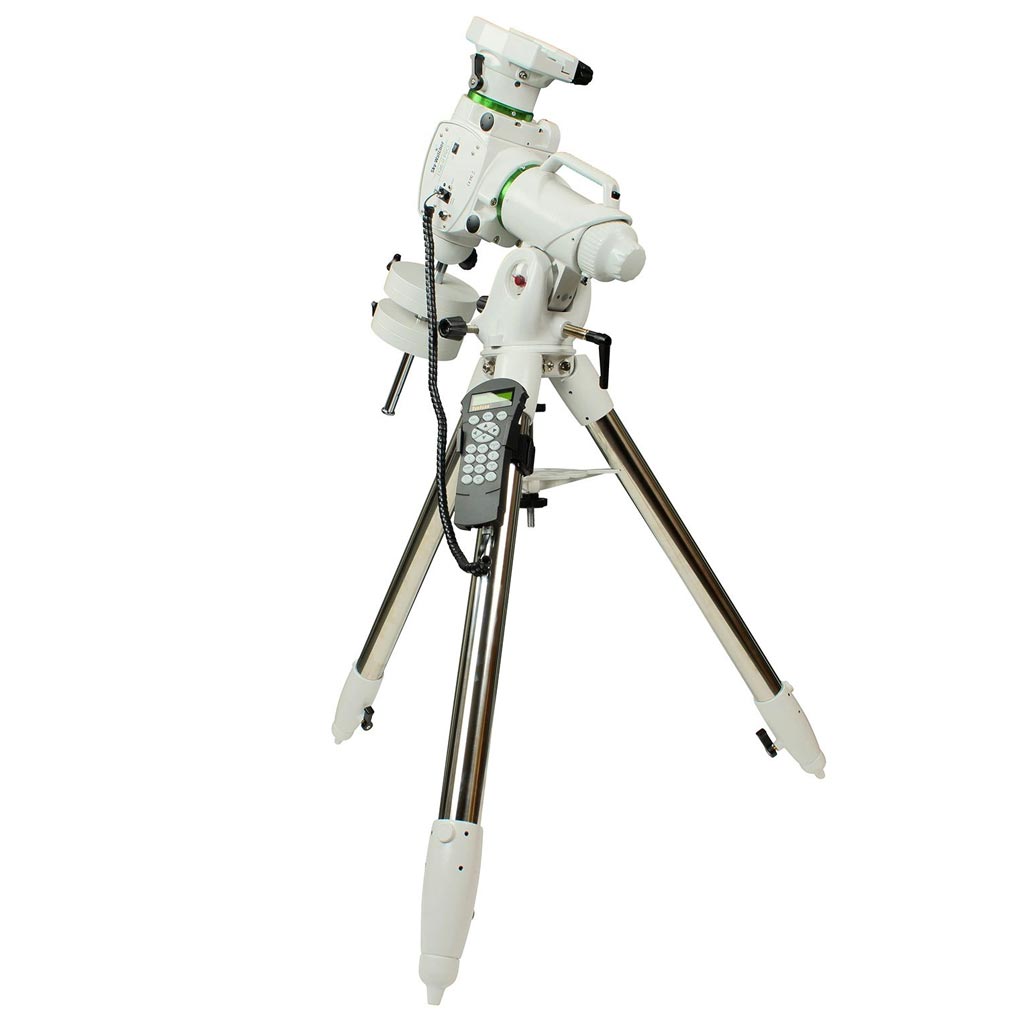
The HD20 has been discontinued by the manufacturer. The Chronos HD32 Mount is the closest alternative. ChronosMount, Inc. - HD20 Mount System with Chronos Central
Oceanside Photo and Telescope is proud to announce Chronos, an innovative telescope mount system with features so surprising, you'll be forwarding this page to every astronomer and astrophotographer you know. How would you like a mount that can handle up to one thousand pounds with no counterweights, no clutches, no meridian flip, and a harmonic drive system where one third of it's 320-tooth system is engaged at any given time? Chronos can do all of those things, and so much more. Let's take a look at why ChronosMount was chosen as a 2009 Sky and Telescope Hot Product!
When it comes to serious visual astronomy, and particularly high quality CCD imaging, all telescope systems require a the use of counterweights. This is simply a necessity to keep the mount balanced and can involve a huge array of different weights and sizes. During the course of an evening, if a change is made to the equipment attached to the mount, then a change to the counterweights is also required - and that can sometimes mean disengaging the drive gears, too. With the revolutionary new ChronosMount design, your approach will be changed forever, because now it is possible to switch between visual and CCD imaging while the mount is still being autoguided. How can you manage to change all of the components and still keep tracking? Because there are no counterweights involved in the process to drag your system down. ChronosMount chose to put more metal in the mount structure and forego the counterweights. By eliminating counterweights, ChronosMount has increased the mount's total load capacity and unleashed the balance burden.
Conventional worm-and-wheel and spur gearing, integral to all astronomical telescope mounts until now, have backlash. It's a fact. Elaborate systems have been "invented" to counteract this basic flaw. The use of spring-loading and the practice of purposely unbalancing the mount to keep one side of the teeth in contact are the most common work-around methods, but nothing quite corrects the error until now. ChronosMount uses harmonic drive gearing and that means no backlash. Nada. Zip. Zero. Harmonic drives are used extensively in high-precision applications such as robotics, integrated circuit wafer manufacturing, integrated circuit component loading, and satellite antenna pointing. Harmonic drives are on the rovers on Mars and keep the adaptive optics aligned on Mauna Kea... And now harmonic drives are available for your telescope.
What makes the harmonic drive work? One-third of the 320 teeth on a harmonic drive unit are engaged at all times, while on worm-and-wheel and spur gearing, there is a maximum of three (3!) teeth engaged. This results in extremely smooth operation over the full 360º of rotation compared to the rough and irregular characteristics of conventional gearing. PEC is the process of filtering out the mechanical errors in the gearing that drives the worm on worm-and-wheel gearing in a telescope mount. It has become the standard by which mounts are measured because the inaccuracies impede effective autoguiding. If PEC is applied, periodic error is smoother, making autoguiding more effective. But does PEC enable no-guide performance? Opinions vary, but our conclusion is that it does not.
Our tests, and the tests done by Dan Phillips, show that the out-of-the-box PEC of a harmonic drive is significantly smoother than worm-and-wheel gearing. In other words, without applying any PEC, harmonic drives are smooth enough to enable effective autoguiding. Additionally, the periodic error period is 14.4 minutes, much longer than the 2.5 - 4 minute period of worm-and-wheel gearing. This improves the autoguiding accuracy as well, because the amount of guiding necessary per minute is much, much less. A worm-and-wheel mount with a 4 minute period and a 5 arcsecond periodic error requires 1.25 arcsecond corrections each minute. Chronos' PE is 7.8 arcseconds, but because of the long period, Chronos only requires 0.51 arcsecond corrections per minute. This is less than half the competition!
Clutches on a telescope mount can introduce a number of opportunities for drive inaccuracies. The reality check is that clutches can slip, causing a loss of position. As clutches are opened and closed, the relationship between the optical path and the gears changes. The specific teeth you used last night are not the same teeth you use tonight to look at the same place in the sky! When permanently mounted, the same harmonic drive teeth are always in the same position in relation to the sky. Periodic error correction inconsistencies are introduced when different gear teeth are used. You use one set of teeth to record your PEC, but when you actually use the mount you are using a different set of teeth to guide.
With a ChronosMount you get a full 90º of Latitude Adjustment... which means it can be used anywhere on Earth without add-on hardware. And guess what? No polar alignment scope is ever needed... With Chronos, you use the main telescope as the polar alignment scope. A simple two-iteration alignment (alignment star/pole star) will result in an accurate enough polar alignment for all CCD imaging requirements. For a more accurate alignment, you simply use the software or use the drift method. What's more, your wiring isn't left dangling "in space" either.
Now, let's talk about the ChronosMount and ChronosCentral - the brains behind the brawn. Integral to ChronosMount is an off-the-shelf servo control system that uses industry-standard electronics and microprocessors. Astronomy-specific functions include a five button handpad for slewing at Guide, Position, and High Speed rates as well as Sidereal tracking without attaching any additional hardware or a computer. Maximum slew speed is 5º per second and there's a stand-alone autoguider port with dry-contact closure protocols and RJ12 pinouts. ChronosMount has included an emergency stop system and an LED slew speed indicator, too. An ASCOM driver is included for use with your favorite PC-based planetarium program, OSX, or Linux. But, because everyone's tastes are different, the planetarium software and PC are not included with ChronosMount.
When you use ChronosCentral, you're using state-of-the-art. You've got a five-button handpad to control the mount when using an optional PC with ASCOM planetarium software installed. At your fingertips you have catalogs which include GSC/GSC2/Hipparcos Catalogs, Vizier Catalogs/Cross Reference, Supernovae and Variable Stars, Asteroids (Ephemerides & Trails), Comets (Ephemerides & Trails), NGC/IC, Hires Clementine Moon Maps and the Messier Objects. When you're operating you can go into modes, such as Tours, Planning, DSS Images, SDSS Images, Real Time Internet Data, Calculators, Internetware, Themes and User Profiles, Hires Clementine Moon Maps, RealSky Images, Colored Stars by Spectral Type, Compatible Aith Aladin Sky Atlas and Real-time updates of asteroid and supernovae data. Want to do your own thing? You can... Because the ChronosMount ChronosCentral includes a PlanMaker feature and allows for optional HP hx2795b iPAQ PDA and Bluetooth wireless connections.
Chronos will change the way you approach astronomy...forever.
ChronosMount Physical Specifications...- Extended RA axis torque tube
- No meridian flip required for most OTA's
- Internet-based firmware updates
- Latitude Adjustment: 0-90 Degrees, 5 degree steps
- Latitude Fine Adjust: +5 degrees, engraved scale
- Azimuth Fine Adjust: +/- 5 degrees, engraved scale
- HD20: Dynamic Load - 1,299lbs, Static Load - 2,023lbs
- No user adjustments over useful life at 3,500rpm input
- Lubrication temperature range -30F to 150F**
- Output Stage - 100:1 on special request
- Total Ratio per axis - 5,000:1
- Maximum Slew Speed: 5 degrees / second*
- 20,000,000; 0.0648 arcseconds / tic with 100:1
- Construction: all CNC aluminum and stainless steel
- HD20: 80lbs in two 40lb pieces
- Periodic Error Period: 14.4 minutes
- Periodic Error Over 360 degrees: Periodic Error - 1.75 arcseconds peak-to-peak per minute or less
- Note: The equatorial head can be custom fitted to whatever pier you want to use.
Chronos Central Specifications - Chronos Central Servo Controller
- Microprocessor Control on distributed RS-485 LAN (one per axis)
- Servo controller for DC motors with incremental encoder feedback
- 32 bit position, velocity and acceleration control
- Trapezoidal and velocity profiling permit on-the-fly parameter changes
- 16 bit PID servo gains can be changed on-the-fly
- Multiaxis coordinated motion control support
- High-speed 2 or 3 channel encoder input, limit switch inputs, hall sensor inputs
- Optional Step and Direction inputs
- Motor current and motor supply voltage sense inputs can be used for amplifier protection
- PWM, Direction and Enable outputs connect directly to many H-Bridge or 3-Phase amplifiers
- Serial interface can be used with RS232 or RS485 multidrop communications
- Complete documentation and example software available on request
- RS-232 Serial (115KBaud) or USB; optional Bluetooth wireless attached to RS-232
- ASCOM including support for planetarium software, filter wheel and dome control (http://www.ascom-standards.org)
- Stand-alone operation includes wired button hand control providing Sidereal Rate tracking, guide, position and high speed slew (wireless on custom quote)
- Microprocessor Controlled (Microchip 18F2620) with ROM software or pass-thru (switch selectable)
- 5vdc for electronics, 24vdc for servo motors (both included)
- Not recommended for battery operation
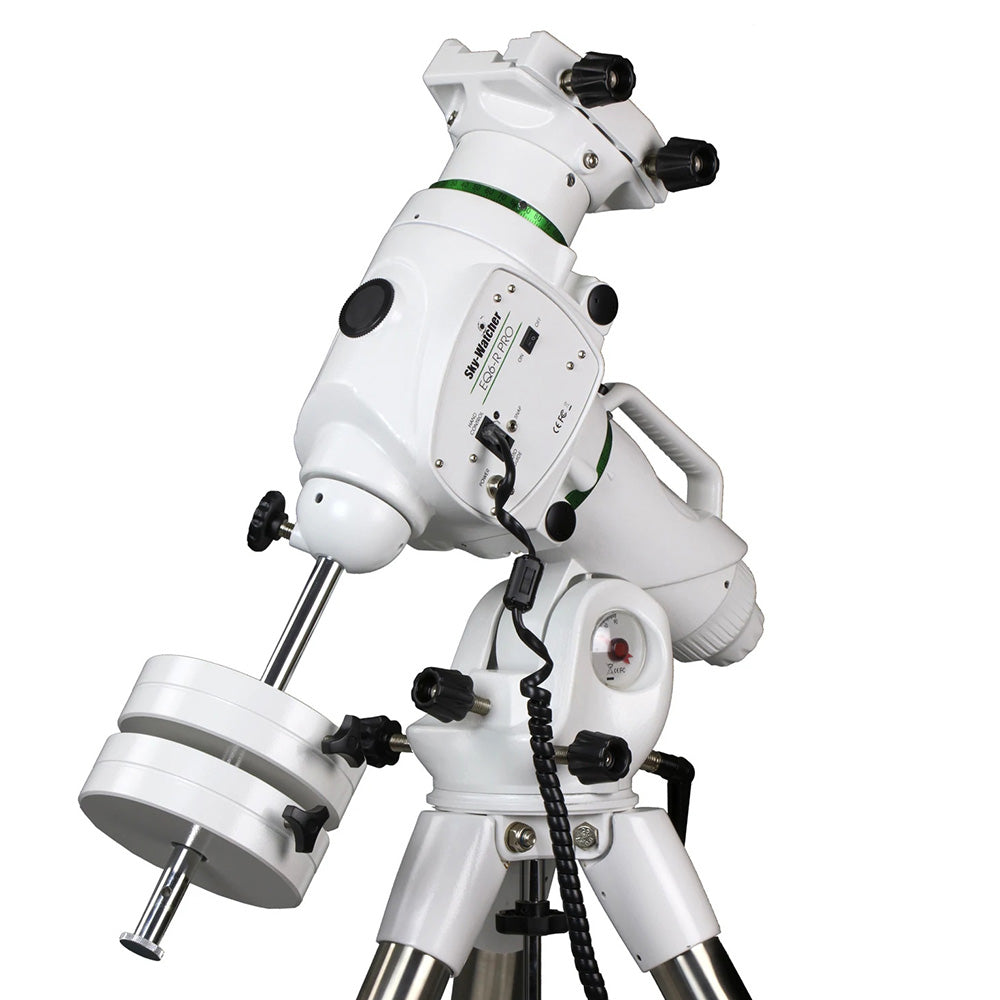
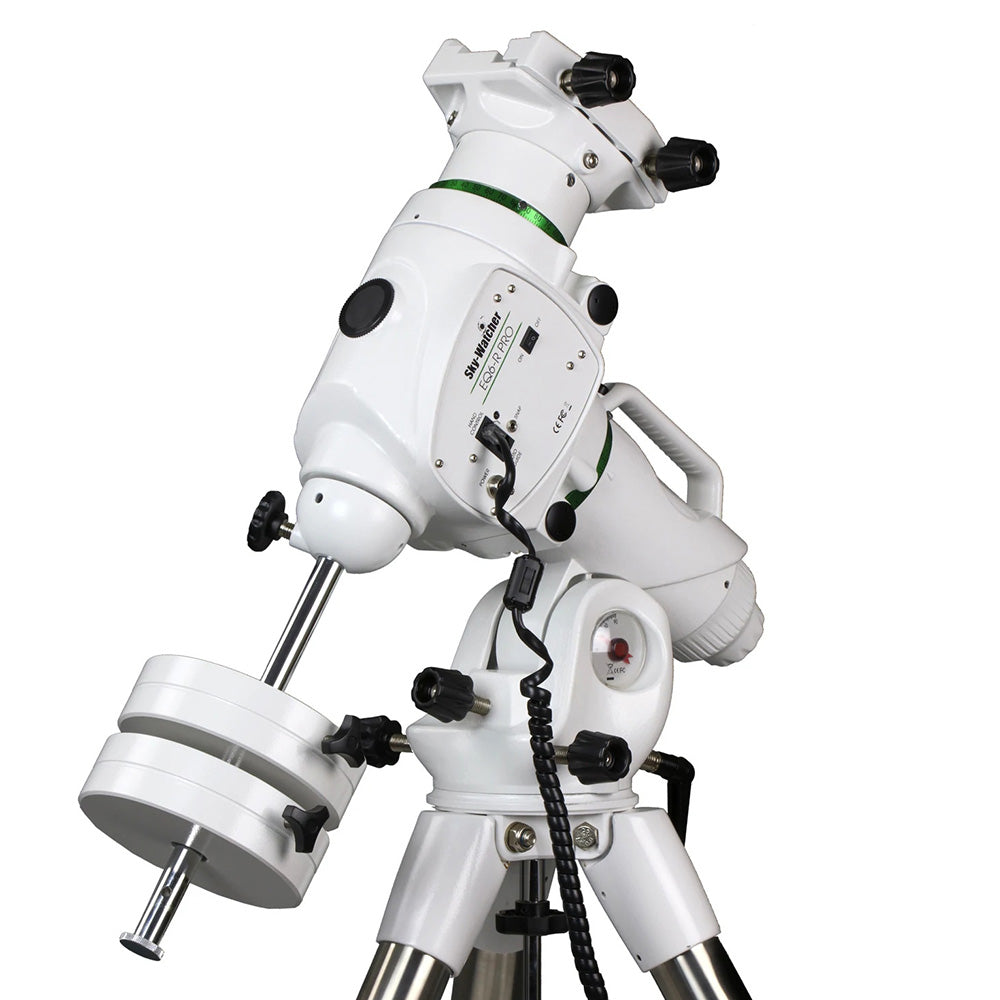
** Maximum slew speeds are lower at temperatures below 30F. Low temperature effects high speed slew speeds only, normal tracking, guiding and position slew performance extends to -30F. Ordering Information for ChronosMountOceanside Photo and Telescope is the exclusive world-wide distributor for Chronos. Each Chronos mount is custom built by hand in the USA and undergoes rigorous mechanical and electronic testing, including on-star tracking tests. Test results will be included with each shipment. Due to the custom nature of the Chronos mount, a 50% non-refundable deposit will be required with each order. Normal wait time is 120 days from date of order. Prices shown includes a universal world-wide power supply, a tripod/pier adapter of your choice (please state your choice in the "comments" section of the shopping cart or give us a call), and a universal dovetail adapter. Pricing does not include a tripod, pier, OTA, or the OTA's dovetail adapter. These items are available from OPT, and can be included in a custom quote. For more information, you can contact OPT by email or by phone at 1-800-483-6287. Thanks! Image shows HD32 with optional telescope OTA's.
ChronosMount, Inc. Product Number: OS-HD20
|
|
|
|