


Home+ Store Info+ Contact+ EDU+ Library+ My Account+ Order History+ Customer Login

Products Information       Search   Featured Products


Solar Filter for Meade SN-8, Skywatcher 8 Kendrick
Solar Filter for Meade SN-8, Skywatcher 8"
Price $138.00
Solar Filter for Celestron 14 Kendrick
Solar Filter for Celestron 14" SCT
Price $138.00
 

Celestron Color Filter Set - #3
Average User Rating

Eyepiece filters are an invaluable aid in lunar and planetary observing. They reduce glare and light scattering, increase contrast through selective filtration, increase definition and resolution, reduce irradiation and lessen eye fatigue. Celestron's filters are made of high quality, solid plane parallel glass with excellent homogeneity. They're anti-reflection coated to prevent glaring and ghosting. All eyepiece filters are threaded to fit Celestron's, and most other manufacturer's, 1¼" eyepieces, and offer a full 26mm clear aperture.

Celestron color filters are mounted in black anodized aluminum cells with the Kodak Wratten Series Number individually engraved, and come available in 4 assorted kits packed in plastic cases. The cells of each filter are double-threaded, so they can be stacked (piggybacked) in various combinations. This allows you to create different color combinations and transmission characteristics, or to have the same color characteristic, but with a lower transmission. When stacking color filters, the effective transmission of the combination you create is equal to the product of the spectral transmission of each of the filters used.

The effectiveness of the filters depends on several factors, including: the aperture and focal length of the telescope, the magnification being used, and seeing conditions.

#23A Light Red (25% transmission): On telescopes of 6" aperture and larger the #23A does approximately the same functions as the #21 filter, but with stronger contrast and enhancement of marginally defined blue-green surface detail. Useful primarily on Jupiter, Saturn, and Mars. Increases contrast between Mercury and bright blue sky during daylight observations or during twilight.

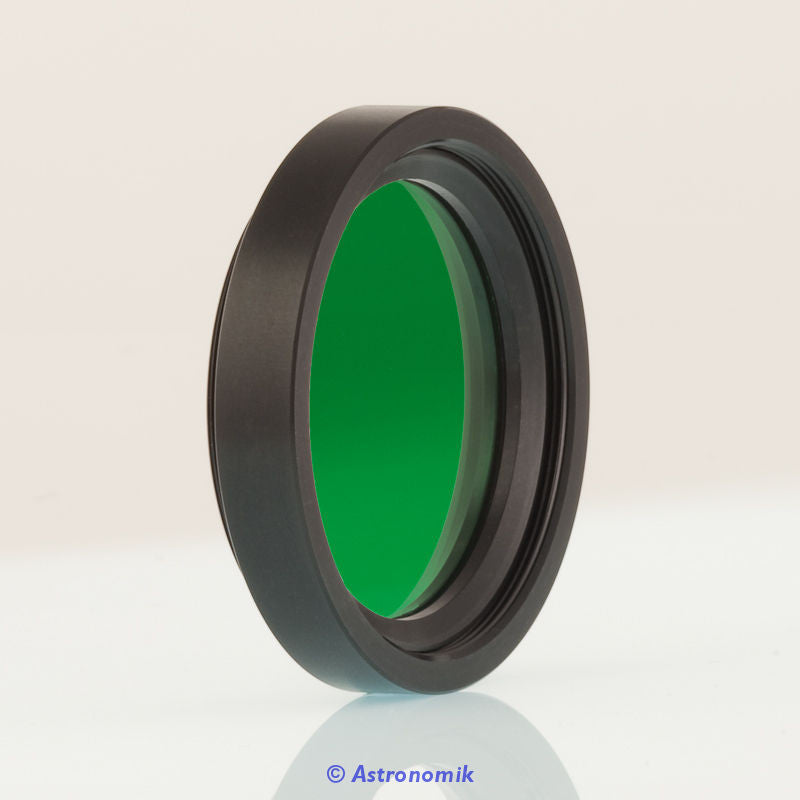
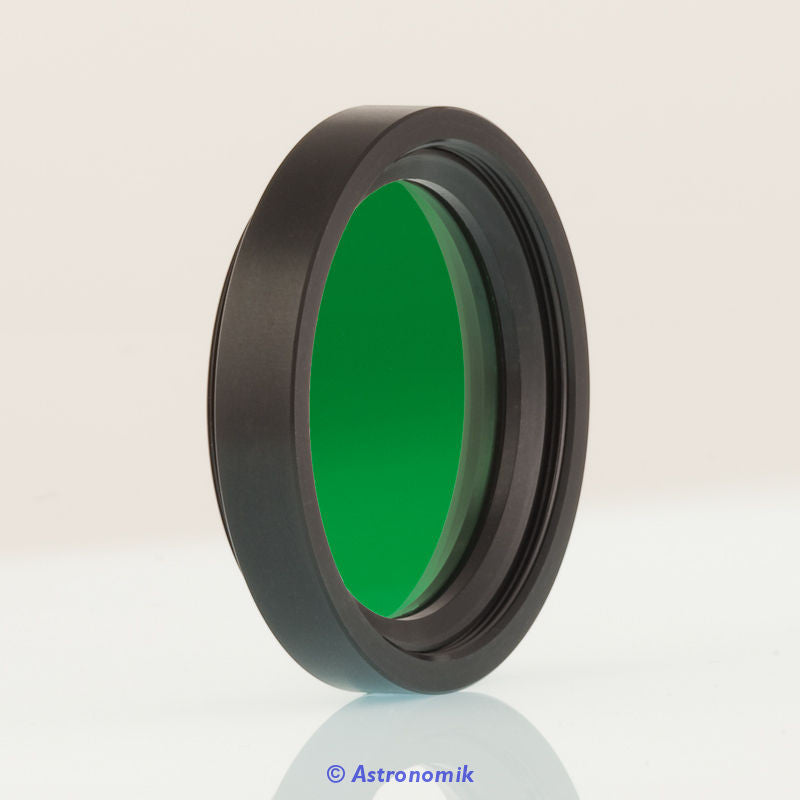
#58 Dark Green (24% transmission): Use on telescopes 8" aperture and larger to reject blue- and red-toned structures on the surface of Jupiter and thereby increase their contrast relative to lighter parts of the disc. Also use for the enhancement of Saturn’s cloud belts and polar regions. Strongly increases contrast of Mars’ polar ice caps, and increases contrast of atmospheric phenomena on Venus.

#38A Dark Blue (17% transmission): A popular filter for the study of Jupiter’s disc, owing to the filter’s strong rejection of orange and red wavelengths. Increases contrast between the reddish belt structures and enhances detail of the Red Spot. Also useful for the study of isolated phenomena, such as dust storms, on Mars, as well as the belt structure of Saturn. Increases contrast of subtle cloud markings on Venus.

Neutral Density (ND3) Filter (50% transmission): Great for the moon and observing bright planets like Venus. Since neutral density filters do not change the color of the object observed, it is excellent for use in planetary viewing. Also reduces glare, brightness, and irradiation on the Moon and planets due to the fact that it only lets 25% of the light coming through your telescope reach your eye. The filter also helps split binary stars where one of the members is significantly brighter than the other. This filter is recommended for telescopes of small aperture (3.5" & under) or with medium aperture telescopes when stacked with other filters.