


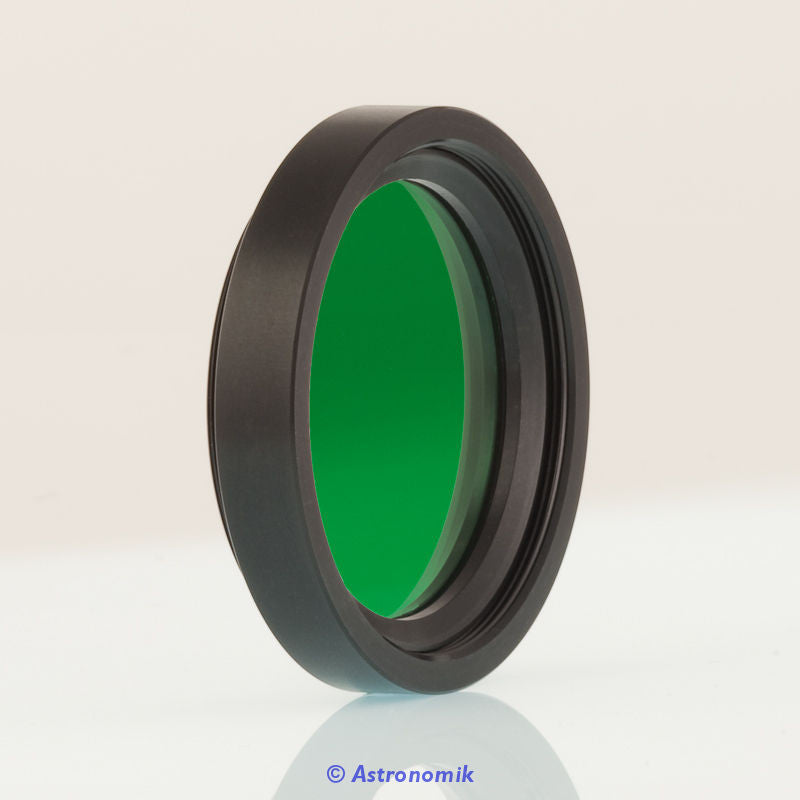
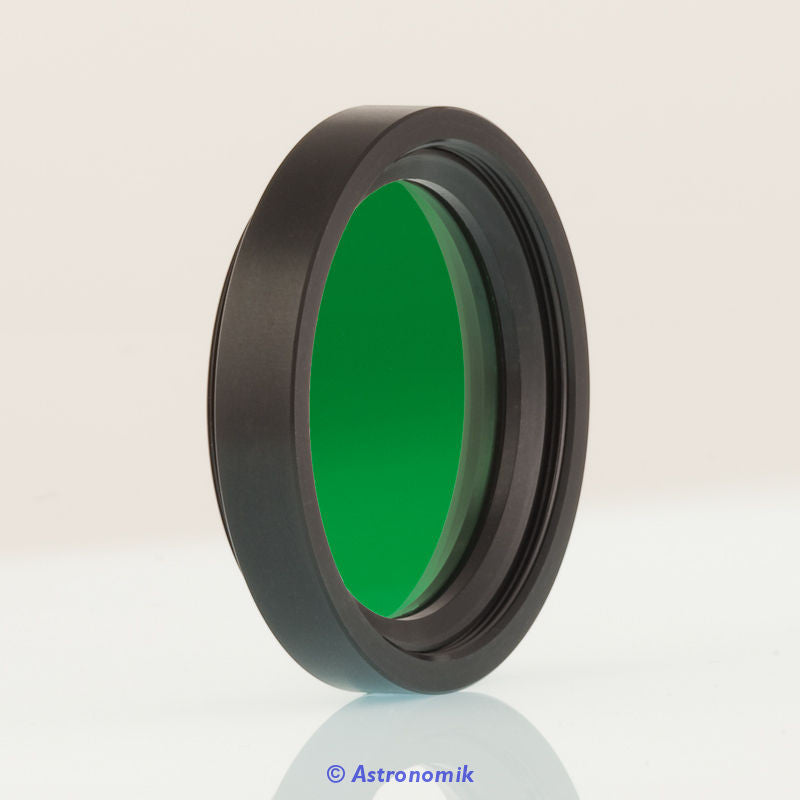


Buying your filters in a set saves you money!Eyepiece filters are an invaluable aid in lunar and planetary observing. They reduce glare and light scattering, increase contrast through selective filtration, increase definition and resolution, reduce irradiation and lessen eye fatigue. Celestron's filters are made of high quality, solid plane parallel glass with excellent homogeneity. They're anti-reflection coated to prevent glaring and ghosting. All eyepiece filters are threaded to fit Celestron's, and most other manufacturer's, 1ΒΌ" eyepieces, and offer a full 26mm clear aperture.
Celestron color filters are mounted in black anodized aluminum cells with the Kodak Wratten Series Number individually engraved, and come available in 4 assorted kits packed in plastic cases. The cells of each filter are double-threaded, so they can be stacked (piggybacked) in various combinations. This allows you to create different color combinations and transmission characteristics, or to have the same color characteristic, but with a lower transmission. When stacking color filters, the effective transmission of the combination you create is equal to the product of the spectral transmission of each of the filters used.
The effectiveness of the filters depends on several factors, including: the aperture and focal length of the telescope, the magnification being used, and seeing conditions.
#21 46% Transmission Orange:
- Moon: Greatly enhances lunar features.
- Jupiter: Improves appearance and detail revealed in structure of Jovian belts. Enhances viewing of festoons and polar regions.
- Mars: Reduces light from the blue and green areas which darken the maria, oases and canal markings, while lightening the orange-hued desert regions. Also sharpens the boundaries of yellow dust clouds.
- Mercury: Reduces the brightness of blue sky during daylight observing to reveal surface features.
- Saturn: Improves structure of the Saturnian bands and highlights blue polar regions.
- Venus: Use during daylight observing to reduce brightness of blue sky.
- Comets: Enhances definition of comet dust tails and heads in larger telescopes (10" and greater aperture).
#15 67% Transmission Deep Yellow:
- Moon: Enhances lunar features.
- Jupiter: Penetrate and darken atmospheric currents containing low-hue blue tones. Enhance orange and red features of the belts and zones. Useful for studies of the polar regions.
- Mars: Reduce light from blue and green areas which darken the maria, oases, and canal markings while lightening the orang-hued desert regions. Also sharpens the boundaries of yellow dust clouds.
- Neptune & Uranus: Improve detail in larger telescopes (10" & larger).
- Saturn: Penetrate and darken atmospheric currents containing low-hue blue tones. Enhances orange and red features of the belts and zones.
- Venus: Reveal low-contrast surface features.
- Comets: Enhances definition of comet dust tails.
#80A 30% Transmission Light Blue:
- Moon: Enhances lunar detail.
- Jupiter: Enhances the boundaries between the reddish belts and adjacent bright zones. Useful for viewing the Great Red Spot.
- Mars: Very useful during the violet clearing. Helpful in studying surface features and polar caps.
- Saturn: Enhance low-contrast features between the belts and zones.
- Venus: Useful for increased contrast of dark shadings in upper Venusian clouds.
- Comets: Enhances definition of comet gas tails.
- Mercury: Improves observation of dusky surface markings at twilight, when the planet is near the horizon.
Polarizing Filter:
Reduces reflected polarized light in the earth's atmosphere.
- Moon & Planets: Invaluable in reducing irradiation and glare.
- Binary Stars: Helpful in splitting binary stars because it reduces glare and diffraction effects around the brighter star of the binary pair.
Celestron Product Number: 94119-10