



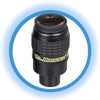


Which eyepiece should I buy?
For any budding visual observer, it is recommended to start off with three eyepieces to start: one low-power, one medium-power, and one high-power. You can, of course, start off with just two or even one. Since many objects in the night sky vary in size and the conditions of the atmosphere can change, it's best to have a few different focal length eyepieces to choose from.
Make sure to also buy the correct sized eyepieces for your telescope. Many beginner telescopes can only accept 1.25" eyepieces, so a 2" eyepiece won't fit.
How do I tell what's a good quality eyepiece?
This is a subjective question, but some features you'll want to look for in a good quality eyepiece are:
- Long eye relief — especially important for eyeglass wearers.
OK: 10mm / Good: 15mm / Great: 20mm & Longer - Large field of view — especially important for deep sky observing.
OK: Under 60º | Good: 60º to 80º | Great: 80º to 100º | Excellent: Over 100º - Price — if the price seems too good to be true, it probably is.
OK: Under $50 | Good: $100 | Great: $200 | Excellent: $200 & Up
Are eyepieces universal?
Yes, eyepieces are universal in that you can use any 2" eyepiece in a 2" telescope focuser. You can also size up an eyepiece — like use a 1.25" eyepiece in a 2" telescope focuser — as long as you have the correct adapter. You cannot, however, use a larger eyepiece with a 2" barrel in a smaller 1.25" telescope focuser. Some eyepieces do offer the ability to be used as both 2" or 1.25", so be sure to look out for those if you have two or more telescopes with different sized focusers.
What's the difference between 1.25", 2", 0.965", and 3" eyepieces?
This number refers to the diameter of the eyepiece where it attaches to the telescope's star diagonal, focuser, or visual back. Almost all entry-level telescopes can accept 1.25" barrel size eyepieces. Intermediate and advanced level telescopes usually accept 2" eyepieces. These larger eyepieces allow for a wider field of view.
0.965" and 3" eyepieces are much less common. 0.965" was an older standard eyepiece size that has since been replaced by the more common 1.25" size. 3" eyepieces are even more rare, and are only useful on very large telescopes.
Which eyepiece is best for observing planets?
The planets are small — and we mean really small — when viewed from Earth, much smaller than most deep sky objects! For that reason, you need a high-power eyepiece, good sky conditions, and ideally a large aperture telescope to see the planets well. For most telescopes, high-power eyepieces begin under 10mm in focal length, but this depends on which telescope is used, too. You can also use a Barlow lens which can magnify the view by 2x or more, but just be sure it's good quality otherwise it may worsen the view.
Which eyepiece is best for observing deep sky objects?
Contrary to planets which require a high-power eyepiece, most deep sky objects are best observed with a low or medium power eyepiece. For most telescopes, that usually means an eyepiece with focal length above 10mm. Since deep sky objects vary so much in size, it's best to have at least 2-3 different focal lengths to choose from. Large aperture telescopes will also be able to resolve fainter deep sky objects with more detail.
Are the eyepieces that come with my telescope any good?
Many entry-level telescopes come with 10mm (high power) and 25mm (low power) Plossl eyepieces. While these eyepieces can be fine for kids and adults who are just getting started, you will see a drastic improvement in the view if you invest in some quality eyepieces. For this reason, if you have enough budget to shop with, we recommend reserving a portion of it for a nice quality eyepiece or two.
How do I attach an eyepiece to my telescope?
This depends on the telescope, but almost all telescopes (with the exception of some scopes designed specifically for astrophotography) come with a star diagonal, focuser, or visual back that can accept eyepieces. Eyepieces slide in to this opening and are held in place by set screws. For refractor and Schmidt-Cassegrain telescopes, a star diagonal makes for comfortable viewing if your telescope did not come with one.